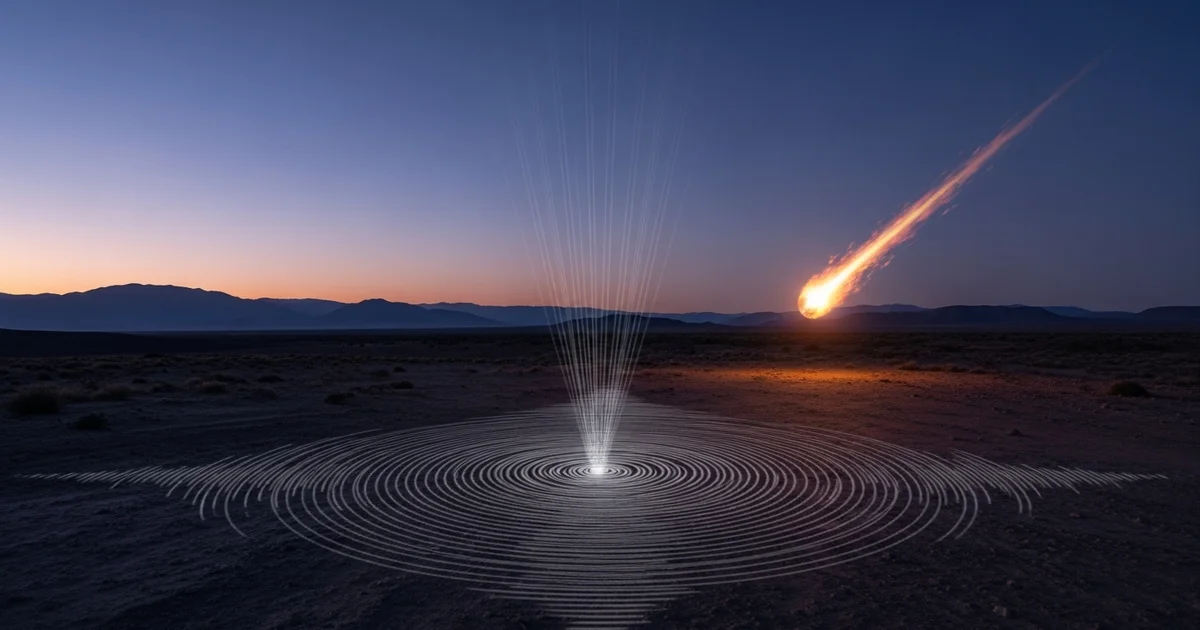
Scientists have shown that earthquake sensors can provide a better way to track space junk as it falls back to Earth.
The research was led by Benjamin Fernando of Johns Hopkins University and Constantinos Charalambous of Imperial College London. Their study shows that these sensors can detect sonic booms and shockwaves from objects traveling faster than the speed of sound. This method provides almost immediate information on the speed and path of falling objects and how they break apart.
Testing the Technology
Researchers tested the approach on April 2, 2024, when a part of the Shenzhou-15 spacecraft—called an orbital module—fell back to Earth. While the module broke apart over Southern California, 124 stations from the Southern California Seismic Network and one station in Nevada recorded its descent.
The data from the earthquake sensors revealed massive gaps in existing tracking. According to the study, the module actually reentered the atmosphere 25 minutes earlier and about 5,300 miles away from where the U.S. Space Track service predicted it would be.
These results show why current tracking systems can be unreliable. Most systems use radar or cameras, which can be blocked by clouds or limited because the government keeps some tracking data secret. Additionally, cameras often fail during "dark flight"—the time when a falling object is no longer hot enough to glow. Earthquake sensors, however, can continue to track an object’s path until it hits the ground or fully breaks up.
Breakup Dynamics
During its descent, the 3,300-pound (1.5-metric-ton) module reached speeds between 19,000 and 23,000 miles per hour—about 25 to 30 times the speed of sound. Its path crossed over Santa Barbara, California, and Las Vegas, Nevada.
Analyzing the data from the earthquake sensors showed the spacecraft didn't just explode once. Instead, it broke apart in a quick series of bursts that occurred every 0.15 to 0.35 seconds.
Environmental and Safety Risks
Tracking debris with earthquake sensors is more important than ever as the amount of junk in orbit grows. A report from the European Space Agency in April 2025 estimated that 1.2 million pieces of hazardous space junk were orbiting the planet.
Beyond tracking for safety, the method helps researchers see how falling debris affects the environment. Scientists noted that tiny particles released as debris burns up in the upper atmosphere are already altering its chemical makeup.
Better tracking also helps response teams find fallen debris quickly. This is essential for recovering toxic materials and preventing pollution on the ground.


