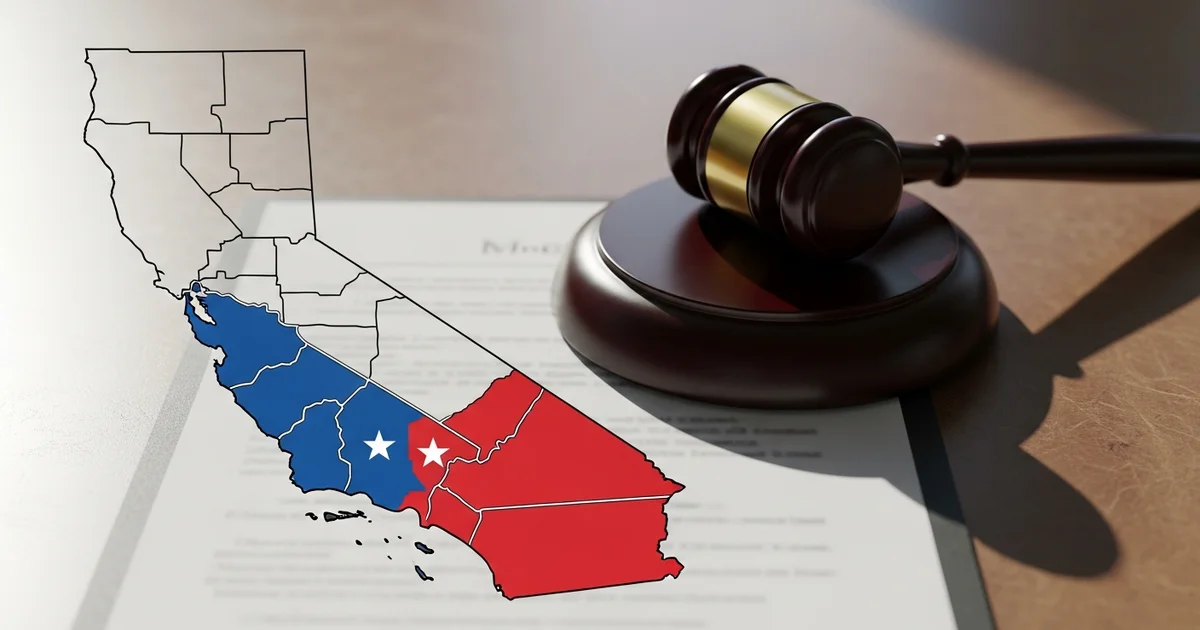
SACRAMENTO — On Wednesday, Jan. 14, a three-judge federal panel voted 2-1 to uphold California’s Proposition 50 redistricting maps. The ruling clears the way for a plan that could significantly change California’s representation in Congress.
The plan to redraw voting districts, supported by Governor Gavin Newsom, aims to help Democrats win five seats currently held by Republicans in the 2026 election. Court records show the new boundaries were drawn to balance out voting map changes made by Republicans in Texas.
Impact on Congressional Districts
The court’s ruling affects five congressional districts, including:
- Districts currently represented by Kevin Kiley (Rocklin), Ken Calvert (Corona), David Valadao (Hanford), and Darrell Issa (Escondido).
- The vacant seat in the Chico area formerly held by the late Doug LaMalfa.
U.S. District Judge Josephine Staton wrote the majority opinion—the decision shared by two of the three judges. She called the maps a legal "political gerrymander," which is a term used when district lines are drawn to favor one political party over another. Staton wrote that the court should focus on what voters and lawmakers wanted, rather than the personal goals of the person who drew the map. During the court proceedings, mapmaker Paul Mitchell declined to explain why he drew the lines the way he did.
Legal Disagreement
Judge Kenneth Lee disagreed with the ruling, arguing that the maps represented an unconstitutional "racial spoils system"—a term for dividing political power based on race. He claimed the boundaries were drawn specifically to benefit one party based on race, citing concerns about district lines in the Central Valley.
California voters previously approved Proposition 50 with 64.4% of the vote. The campaign for the measure was one of the most expensive in California history. According to reporting from CalMatters, supporters spent approximately $120 million to get the measure passed.
Next Steps
Assemblymember David Tangipa, who joined the lawsuit challenging the maps, said the legal team is deciding its next steps. They are considering an appeal to the U.S. Supreme Court, though no final decision has been made.
The ruling comes as the state prepares for the 2026 elections. The new boundaries will likely play a major role in the fight for control of the U.S. House of Representatives.


