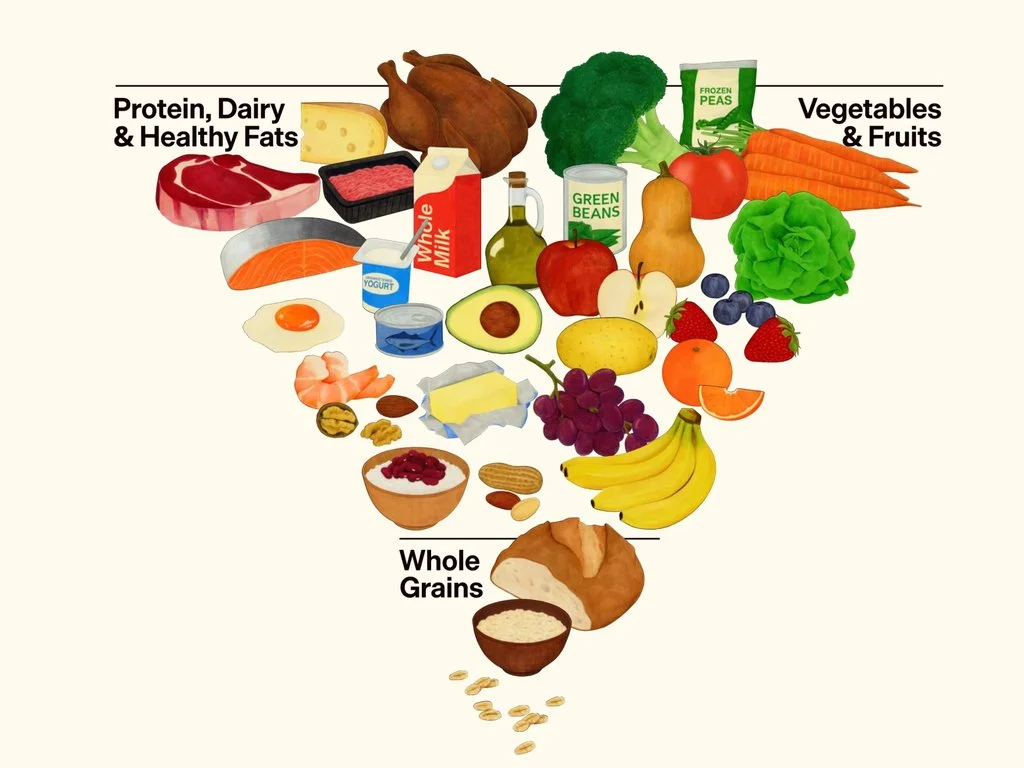
WASHINGTON — On January 7, 2026, Health and Human Services Secretary Robert F. Kennedy, Jr. and U.S. Department of Agriculture Secretary Brooke Rollins officially launched the 2025–2030 Dietary Guidelines for Americans. The updated standards represent a major shift in federal nutrition policy, focusing on whole foods to address what officials described as a national health crisis.
The new guidelines use an "upside-down" food pyramid that flips the traditional triangle to reduce the emphasis on grains. In this new layout, protein and healthy fats occupy the wide top section to show they are the most important parts of the daily diet. Whole grains, which were the wide foundation of previous versions, have been moved to the narrow point at the bottom of the new chart.
These standards set the rules for all federal food programs. This includes the National School Lunch Program, Head Start, and meals served to the military and veterans.
Focus on Protein and Healthy Fats
The 2025–2030 standards call for eating significantly more protein. The guidelines recommend roughly 0.54 to 0.73 grams of protein for every pound a person weighs. Under these standards, a 150-pound person would aim for approximately 82 to 109 grams of protein per day. Health officials suggest getting this protein from sources like red meat, poultry, eggs, and seafood.
In addition to more protein, the new policy moves away from earlier limits on saturated fats by encouraging full-fat dairy products like whole milk and butter. Other recommended sources for healthy fats include avocados, olives, nuts, seeds, and seafood.
Reductions in Sugar and Processed Foods
The guidelines advise the public to significantly cut back on added sugars. In fact, the new chart removes the category entirely to show it is not a necessary part of a healthy diet. While added sugars are discouraged, the guidelines still encourage eating fruit and dairy, which contain natural sugars.
Officials also warned that "ultra-processed foods"—like sugary cereals, sodas, and boxed snacks—are linked to long-term illness and inflammation. Inflammation is the body's response to stress and irritation. Health officials advise people to eat far less of these products and artificial additives.
National Health and Security
Health data drove the change, showing that nearly 90% of U.S. healthcare spending goes toward chronic, or long-term, diseases. Currently, over 70% of U.S. adults are overweight or obese, and nearly one-third of teenagers are prediabetic. This means their blood sugar levels are high enough to put them at risk for developing diabetes.
Officials also identified diet-related illnesses as a threat to national security. The high rate of these conditions prevents many young Americans from serving in the military, making it harder to find healthy recruits.
Specialized Guidance
The policy includes specialized nutrition advice for infants, seniors, pregnant or breastfeeding women, and people on vegetarian or vegan diets. The guidelines suggest eating fermented foods, such as yogurt or kefir (a fermented milk drink), to support the microbiome. This is the collection of helpful bacteria in the gut.
Health officials still encourage drinking water and other sugar-free drinks while advising the public to limit alcohol. For more information and helpful guides, the public can visit the federal website at realfood.gov.


