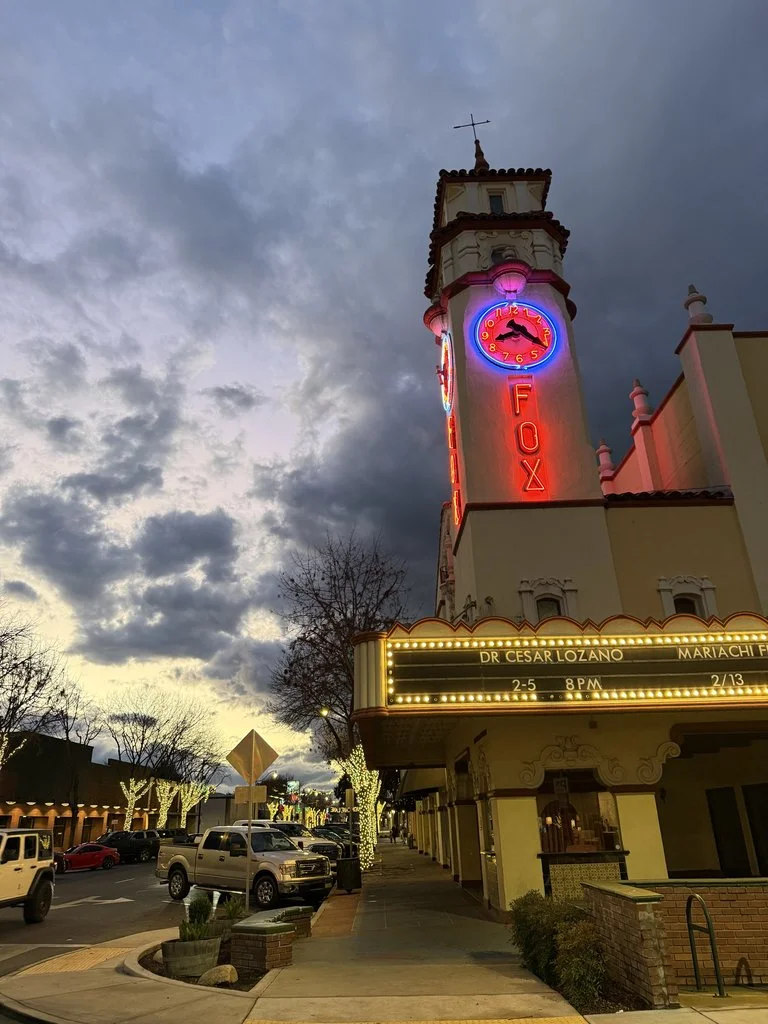
The Visalia Fox Theatre is a major cultural landmark for the city and the surrounding area. Originally built as a grand movie palace, the venue now serves as a performing arts center and the home of the Tulare County Symphony.
The history of the Fox in Visalia began in January 1928, when the William Fox film company bought 250 theaters from the West Coast Theatres chain. The deal included the old Visalia Theatre at the corner of Court and Acequia streets. That building had originally served as a National Guard Armory in 1889.
After the 1928 deal, Fox bought separate land at the northwest corner of Main and Encina streets to build a more modern cinema. Architects Clifford Balch and Floyd Stanbery designed the building with a Spanish-style exterior and a landmark clock tower. The new theater was built between 1929 and 1930 at a cost of $225,000.
The interior was designed in an "atmospheric" style, a popular theme at the time that made the theater look like a South Asian temple garden. By using paint and plaster to mimic expensive materials, designers created a ceiling that resembles a starry night sky.
When the Visalia Fox Theatre opened on February 27, 1930, it featured the latest technology. It was equipped with Western Electric audio equipment and specialized acoustic walls designed for sound films, often called "talkies." The opening night program began at 6:30 p.m. and included a talking western film, short news films called newsreels, and a performance on the theater’s $20,000 organ. At the time, the auditorium held 1,460 seats.
In 1976, the Mann Theater Corporation split the theater into three screens to help it compete with newer, larger cinemas in the city. However, the theater eventually closed in late 1996 after a new 12-screen cinema opened at the Sequoia Mall.
The closure prompted local teacher Rami Cherami to form a non-profit group called "Friends of the Fox." This began a three-year effort to save and restore the building. In December 1997, the owners donated the property to the group, allowing the restoration to move forward without any debt. The project aimed to return the building to its original layout as a single theater.
On November 20, 1999, the theater held a grand re-opening as a performing arts venue with a sold-out performance by Marvin Hamlisch. The restored theater now has a capacity of 1,275 seats. In 2011, management applied for the theater to be listed on the National Register of Historic Places, a status that honors the building’s history and helps protect it for future generations.


